Sleep design · Ergonomics · Mattress engineering
How Adjustable Bed Design Is Evolving for Personalized Sleep
A bed used to be a persuasive argument for remaining horizontal. The adjustable bed proposes a more nuanced arrangement: raise the head, lift the legs, pause at a reading angle, return to flat. Its promise is not that one position suits everyone, but that a sleeper can make small changes to suit the hour, the body, and the ordinary business of being awake in bed.
For much of its history, the mattress was the principal subject of sleep design. Its springs, foam, stuffing, and ticking received the attention; the frame beneath them was expected to hold still and keep quiet. Adjustable bases change that hierarchy. The foundation becomes a moving structure, and the mattress must move with it. Motors, hinges, joints, remote controls, and the less glamorous question of where the power cord goes join the conversation about softness and support.
This shift is part of a wider interest in personalized sleep: the recognition that comfort is not a single setting, and that a bedroom is used for more than the interval between lights-out and morning. People read, watch, work, recover, and sometimes simply try to find a position in which their back or shoulders are less insistent. Adjustable bed design makes those transitions possible without requiring a new piece of furniture for each one.
The engineering is straightforward in principle, though not always in practice. A powered base changes the angle of one or more sections of its platform. The upper body may rise independently; the legs may lift or bend; some designs coordinate these movements. But the everyday success of the system depends on more than its range of motion. Stability, noise, mattress compatibility, controls, and the habits of the person using it all matter. A bed can move in many directions and still be wrong for the room, the sleeper, or the mattress placed on it.
From fixed frame to responsive platform
A conventional bed makes a simple promise: it will remain where it is put. An adjustable base adds a mechanical vocabulary to that promise. Beneath the mattress, a supporting deck is divided into sections, commonly corresponding to the head, torso, and legs. Motors move these sections around pivot points. The base must distribute weight across the platform while remaining steady through repeated changes of position.
That description makes the technology sound more dramatic than it usually feels. In a well-designed system, movement is gradual and contained. The head section rises; the mattress follows. The legs lift; the joints accommodate the change. A user may notice the result more than the mechanism, which is generally the point. The machinery should not become the main character in an otherwise quiet room.
Earlier adjustable beds were often associated with hospitals, rehabilitation, or specialized care. Their modern domestic descendants have broadened the context. Some people use a raised head position for reading or watching television; others value the option of lifting the legs or altering the angle of the torso. Such preferences are individual, and a feature that feels useful to one sleeper may be irrelevant to another. Adjustability offers choice, not a universal prescription.
That distinction is important. A moving base is a piece of furniture, not a diagnosis or treatment. People with ongoing pain, breathing concerns, circulation issues, or other health questions should seek guidance from a qualified clinician rather than assume that a particular angle will solve them. The design question is more modest: can a bed make it easier to find and repeat a comfortable position?
The geometry of comfort
Adjustable beds are often described by their “articulation,” the ability of the platform to bend at selected points. That word can sound like a technical flourish, but it names a practical matter. Where does the bed bend? How far can each section move? Does the movement feel smooth? Does the platform return to flat without a jolt? The answers shape the range of positions a sleeper can actually use.
Head elevation is among the most familiar adjustments. Raising the upper body can create a more upright posture for reading, conversation, or other activities done in bed. A modest incline may feel natural; a steep one may produce pressure at the hips or make a pillow feel misplaced. The ideal angle cannot be read from a specification sheet. It is discovered through use, and it may change depending on what the person is doing.
Leg elevation introduces a separate set of sensations. It can change pressure at the knees and hips and alter how the lower body rests against the mattress. Some bases use a “zero-gravity” or similar preset label to describe a coordinated position, typically involving raised head and leg sections. The name is evocative, but gravity remains present. Such presets are best understood as convenient starting points rather than as scientifically guaranteed states of weightlessness or improved sleep.
The evolution of adjustable bed design has therefore been less about inventing a single ideal posture than about widening the available range. A well-considered system makes it possible to move in small increments and settle at a position that feels tolerable, rather than forcing the sleeper into a handful of dramatic presets. Fine control can be more useful than spectacle: an adjustment of a few degrees may matter more at bedtime than a feature with a grand name.
The mattress has to move, too
A base is only half the arrangement. The mattress must flex as the platform changes shape, and different materials respond differently to that demand. A mattress designed for a rigid foundation may not behave as intended when repeatedly bent. The construction should be checked for compatibility with an adjustable base before the two are paired.
Foam and latex mattresses are often considered for adjustable setups because their layers can flex with the platform, though the details vary by construction. Innerspring and hybrid designs may also be compatible, but their coil systems, perimeter structures, and internal reinforcements can affect how readily they articulate. The material name alone is not enough to settle the question. Manufacturer guidance for the specific mattress and base is the practical reference.
Layered construction can make flexibility easier to understand. A mattress built from distinct comfort and support layers may bend differently from one built around a highly rigid perimeter or a tightly integrated support unit. The cover, quilting, and edge construction play their parts as well. Bending repeatedly can place strain on seams and materials, so compatibility is not simply a matter of whether a mattress can be made to bend once.
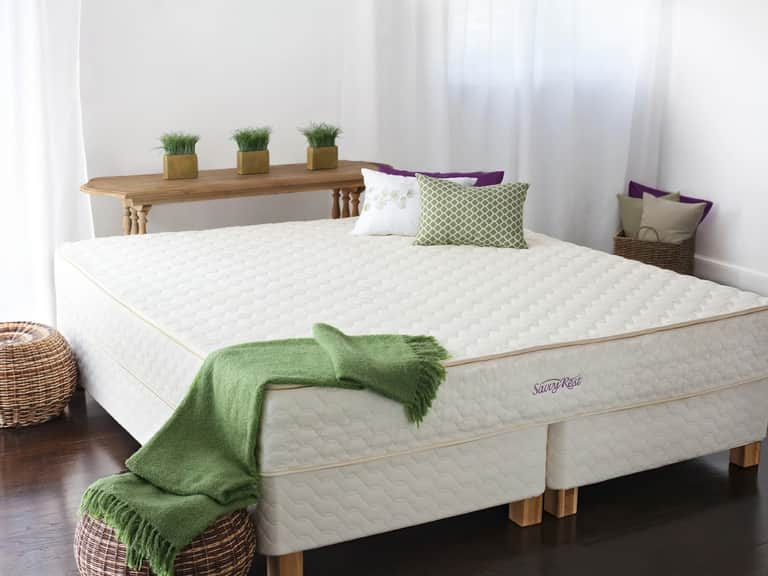
For example, the Savvy Rest Serenity Latex Mattress is described as usable on an adjustable bed base. It is a 10-inch, three-layer latex mattress with customizable firmness layers and an organic cotton cover quilted with wool. That information makes it a relevant example of a mattress whose stated design includes adjustable-base compatibility; it does not mean every latex mattress will behave the same way, or that any one configuration will suit every sleeper. Checking the exact mattress specifications remains essential.
Compatibility also includes the less poetic question of fit. The mattress should remain properly positioned as the platform moves. Sheets and protectors must accommodate articulation without pulling tight, slipping off, or bunching into uncomfortable folds. Deep-pocket fitted sheets may help with some combinations, but dimensions and elastic construction vary. A bedding setup that is comfortable on a flat bed may need adjustment when the head and foot sections rise regularly.
Noise, steadiness, and the domestic test
Engineering is often judged in the laboratory by measurable performance. At home, it is also judged at midnight. A motor that sounds acceptable in a showroom may feel conspicuous in a quiet bedroom. A base that rocks slightly when changing position may be a minor curiosity during a demonstration and an irritant after months of use. These qualities do not always appear in a headline feature list, yet they shape whether a person reaches for the remote at all.
Noise depends on the motor, the frame, the floor, and the way the system is installed. A base that is not level may transmit movement differently from one resting securely on a stable surface. The bed’s weight and the room’s acoustics matter, too. Soft furnishings can absorb some sound; a hollow floor or a wall shared with another room may make it more noticeable. A useful evaluation asks not only how loud the mechanism is, but how it sounds during the gradual movements likely to happen at night.
Stability is similarly cumulative. The platform should support the mattress and occupants without feeling fragile or wandering under normal use. Its legs, frame, joints, and moving sections work together, and the floor beneath them is part of the system. Weight limits and installation instructions deserve attention, especially when a base is used with a substantial mattress. If a bed is shared, each person’s movements and preferences should be considered rather than treating the mattress as a solitary instrument.
Ease of setup belongs in the same category. Adjustable bases can be heavy, and some arrive in sections that must be assembled. Access to outlets, the placement of cords, clearance around the frame, and the route through a hallway or stairwell are unglamorous but consequential details. An elegant piece of engineering is less elegant when it cannot pass through the bedroom door.
Controls that invite use
The control system is the part of adjustable bed design most directly encountered by the sleeper. A remote may offer buttons for individual movements, saved positions, or presets. Some systems use wired controls, others wireless ones, and some offer app-based functions. More features can be useful, but only if the interface is legible, reliable, and easy to use while tired.
There is a difference between possibility and usability. A base may have a long list of settings, yet a sleeper may use only two: flat and a preferred reading position. This is not a failure of imagination. It is evidence that daily technology succeeds when it reduces friction. Large, clearly marked buttons and predictable movement may matter more than a menu of options that requires a lesson.
Preset positions can make repetition simple. A person who finds a comfortable setting can return to it without reconstructing the angle each evening. Yet presets should not be confused with recommendations. Labels such as “lounge” or “zero gravity” describe a product’s chosen shorthand, not a guarantee about health outcomes. The useful question is whether the setting feels comfortable and suits the activity at hand.
As controls become more connected, practical questions multiply. Does the base still work if a phone is elsewhere or a wireless connection fails? Is the remote easy to locate in the dark? Can settings be changed without disturbing someone on the other side of the bed? A restrained interface, with essential movement available directly, can be a virtue. The best design may be the one that lets its owner forget how much design is involved.
Two sleepers, one platform
Personalization becomes more complicated in a shared bed. One person may like a raised head position while the other prefers to remain flat. Split adjustable configurations address this by allowing each side to move independently, typically with separate mattresses or divided surfaces. They create a small but meaningful freedom: the couple need not negotiate a single angle as if it were a constitutional question.
There are trade-offs. A split arrangement can create a seam or gap between sides, and bedding may need to be selected accordingly. The bases must fit the room and work with the frame, mattress, and sheets. Separate movement also means separate controls and, sometimes, separate habits. A couple should consider whether independent positioning is valuable enough to justify the additional complexity.
Mattress construction can accommodate this kind of difference in other ways, too. Some mattresses permit different firmness configurations on each side, while an adjustable base changes the angle of the platform itself. These are related but distinct forms of personalization. One changes how the surface responds to pressure; the other changes the position of the sleeping surface. Neither substitutes automatically for the other.
In evaluating a shared setup, the useful details are concrete: whether movements on one side disturb the other, how the center seam feels, whether each person can reach a control, and whether the room has enough clearance. A showroom demonstration can help, but a few minutes of trying positions cannot reproduce every night of use. Expectations should remain grounded in the actual design and the household’s routines.
A changing idea of the bedroom
Adjustable beds are part of a broader shift in how people think about the bedroom. It is no longer treated only as a place where sleep begins and ends. It is also a room for reading, resting during illness, easing into the morning, or sitting upright when lying flat is not comfortable. The adjustable base gives those activities a more deliberate setting.
That does not make a bedroom an office or a hospital ward. The appeal is precisely that one surface can serve several purposes without requiring the sleeper to stack pillows into an unstable arrangement. A controlled incline can be easier to maintain than a pile of cushions that shifts, compresses, and gradually migrates toward the headboard. Still, a mechanical solution should not be mistaken for an answer to every discomfort. Pillows, mattress support, room temperature, and personal health all remain part of the picture.
There is also a quiet design challenge in fitting machinery into a space associated with softness. A base must accommodate motors and moving joints while keeping the bed visually calm. Some systems are designed to work within a traditional bed frame; others have a more visible, utilitarian appearance. The right choice depends on the room, the frame, and how much the owner values a concealed mechanism over easy access for maintenance.
As adjustable beds become more familiar, their design may be judged less by novelty and more by how naturally they fit into ordinary life. A quiet motor, a secure mattress, a control that makes sense, and a comfortable transition from flat to raised are not spectacular achievements. They are the foundations of trust. When the system works well, the sleeper is free to think about the book, the conversation, or the sleep that may eventually follow.
How to assess an adjustable bed thoughtfully
Choosing an adjustable base is less a hunt for the most elaborate feature list than an exercise in identifying needs. The following questions help turn the abstract promise of customization into a practical evaluation:
- Which movements will be used? Consider whether head elevation, leg elevation, or independent sections have a clear purpose in everyday routines.
- Is the mattress compatible? Check the exact model’s specifications and guidance, not just its material category or a general claim about flexibility.
- How does the base sound and feel? Listen during movement and notice rocking, vibration, or abrupt transitions.
- Are the controls intuitive? Look for clear operation, accessible buttons, and dependable return to a preferred position.
- Will it fit the room? Measure the frame, mattress, floor space, outlet access, and clearance for movement and installation.
- What changes in the bedding? Consider sheet fit, mattress protectors, and whether the bed’s movement causes fabric to pull or bunch.
- Is independent movement important? Shared sleepers should weigh the benefits of separate adjustment against seams, bedding needs, and added complexity.
These questions are deliberately ordinary. Adjustable beds are often marketed through the drama of the machine: the remote, the motor, the rising platform. But a bed is lived with in the small hours, when design is measured by whether it helps without asking for attention. The quieter the system’s contribution, the more likely it is to become part of a routine rather than a novelty.
The future is likely to be more personal, not more theatrical
Innovation in adjustable bed design does not have to mean ever more elaborate movement or an expanding catalogue of presets. It may instead involve better coordination between base and mattress, smoother transitions, quieter operation, more dependable controls, and clearer information about compatibility. Those improvements are not dramatic, but they address the places where design meets daily use.
Personalized sleep is an appealing phrase because it suggests that comfort can be tailored rather than prescribed. Yet personalization is most useful when it remains honest about its limits. A base can provide positions; it cannot decide which one is right for a particular body. It can make a routine more convenient; it cannot guarantee restorative sleep. Its value lies in offering a range of choices that the sleeper can test and adapt.
The bed, once a stubbornly static object, is becoming a small piece of domestic infrastructure. It supports sleep, but also the transitions around it: the evening book, the morning pause, the need to change position. Its engineering is most successful when it disappears into those moments. The future of adjustable bed design may therefore be measured not by how far a platform can rise, but by how gracefully it makes room for the different ways people want to rest.