Bedding · Materials and design
How Wool and Cotton Layers Influence Mattress Protection
A mattress protector is a modest object with a consequential job: it must take the small, repeated disturbances of ordinary life without making the bed feel like a different bed. Wool and cotton help explain how that balancing act works. In Vispring’s Lux Skirted Mattress Protector, cotton forms the outer fabric and wool the filling, a pairing that brings questions of airflow, moisture, surface feel, and care into view.
Published November 19, 2026
There is a particular confidence to a made bed. Sheets are drawn smooth, pillows arranged, the mattress hidden beneath a sequence of layers whose individual contributions are easy to overlook. A protector is often the least visible of them. It does not promise a new sleep experience so much as defend the existing one: quietly, repeatedly, and, one hopes, without announcing itself.
Yet a protector is not merely a barrier. Its fabric and filling can influence how the sleeping surface feels and how it handles warmth and moisture. A cotton cover and a wool filling, for instance, behave differently from a slick synthetic film or a densely padded foam layer. Understanding those differences makes it easier to see why a protector’s materials matter—and why care instructions are part of its design, not an afterthought.
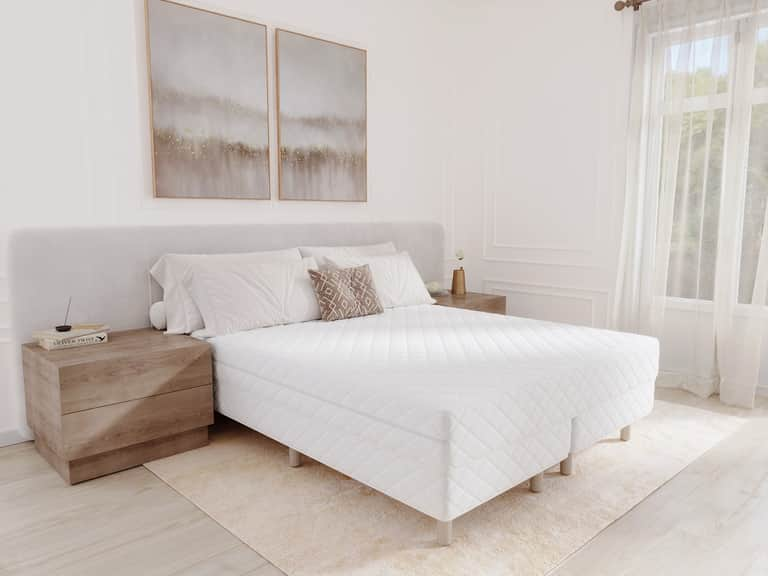
Vispring bedding offers a useful example. The Vispring Lux Skirted Mattress Protector is described as having a cotton outer fabric, British wool filling, a quilted construction, and a fitted design with an elasticated skirt. It is intended to provide a washable layer between sleeper and mattress while adding a little softness. Those details do not guarantee a particular experience for every person or climate. They do, however, give us a practical way to examine what cotton and wool can contribute.
Protection is a materials question
People commonly turn to mattress protection for reasons that are pleasingly unromantic: perspiration, body oils, dust, accidental spills, and the ordinary wear that accumulates with use. A protector can help keep those things from reaching the mattress itself. Its effectiveness depends on its construction. A quilted cotton-and-wool pad is not the same kind of product as a fully waterproof encasement, and the distinction matters.
In a quilted protector, layers are stitched together to hold the filling in place and create a continuous padded surface. This format can reduce direct contact between the sleeper and the mattress cover, and it may make routine laundering more manageable than cleaning the mattress. But unless a product is specifically described as waterproof, it should not be assumed to stop liquid from passing through. Wool and cotton may absorb and redistribute some moisture; that is not the same as providing a liquid-proof barrier.
The difference is best understood as one between managing everyday contact and blocking a spill. A soft, breathable pad may suit someone seeking a washable, lightly cushioned layer. A household that needs stronger protection from incontinence, repeated spills, or other substantial liquid exposure may require a purpose-built waterproof design. Reading the specifications—not simply the word “protector”—is the quiet but necessary work of choosing.
That distinction also prevents an easy misunderstanding about natural materials. Cotton and wool have useful physical characteristics, but they are not magic. Their performance depends on how the fibers are processed, how the product is assembled, whether there are additional membranes or treatments, and how it is maintained.
What cotton brings to the surface
Cotton is familiar partly because it is everywhere in bedding, but familiarity should not be mistaken for sameness. The feel and function of cotton depend on the yarn, weave or knit, fabric weight, finishing, and quilting. In a mattress protector, the outer textile is the part most likely to be noticed first: it sits between the sleeper and the filling, and, in many designs, between the filling and the mattress beneath.
A cotton fabric can feel soft and textile-like rather than slick. Its surface may preserve more of the sensation of the mattress than a thick or heavily padded overlay, though the complete effect depends on the protector’s loft and the bedding placed above it. Cotton is also absorbent. In a layered bed, that can help it take up some moisture near the surface, but absorbency is not synonymous with rapid drying. Damp textiles still need an opportunity to release moisture through ventilation and, when appropriate, laundering and thorough drying.
Breathability is often used as shorthand for comfort, though the word can cover several related ideas. Air may move through an open fabric more readily than through a continuous waterproof film. At the same time, the actual temperature experienced by a sleeper is shaped by the entire bed: mattress materials, sheets, room temperature, humidity, sleepwear, and personal physiology all have a part in it. A cotton cover may contribute to a less sealed feeling, but it cannot by itself promise that someone will sleep cool.
Fit is another practical contribution. The Vispring Lux protector is described as having a pocket and a fully elasticated skirt, details intended to keep it secured around a mattress. A pad that fits poorly can wrinkle, shift, or bunch; even a pleasant fabric becomes irritating if it gathers beneath the body. Before buying any fitted protector, it is useful to check mattress dimensions and depth, including any existing topper that changes the total height.
Wool as a filling: warmth, loft, and moisture
Wool brings a different character to the arrangement. Rather than serving as the exposed fabric, it sits inside the quilted layer, where it contributes loft and a cushioned hand. Its fibers have a naturally crimped structure, and a wool filling can create a soft, resilient layer rather than the flat, crisp sensation associated with a plain textile. How substantial that layer feels depends on the amount of wool and the way the pad is quilted.
Wool is also known for its relationship with moisture. It can take up water vapor within the fiber structure, which may help moderate the feel of moisture around the sleeping surface. In practical terms, a wool-filled protector may feel more accommodating in a bed where temperature and humidity change over the night. That does not mean it removes perspiration from the bedroom or guarantees a dry sleep. Moisture still has to go somewhere; room conditions, airflow, and the rest of the bedding remain important.
There is a small but useful distinction between managing vapor and containing liquid. A wool layer may absorb moisture, but it should not be treated as waterproof unless the product’s construction explicitly says so. If a spill reaches the filling, it can require more attention than a simple surface wipe. That is one reason care guidance matters so much for wool-rich bedding: a natural material may be comfortable and durable when properly maintained, while still having specific limits on washing and drying.
Wool can also contribute warmth, although the result is not a simple matter of “warm” or “cool.” A thin wool layer might add gentle cushioning without making a bed feel dramatically different. A thicker one may be more noticeable. The sleeper’s own temperature sensitivity, the room, and the other layers can outweigh the material’s reputation. As with most bedding, the relevant question is less what a fiber is said to do in general than how this particular construction feels in the setting where it will be used.
Why cotton and wool work as a combination
Placed together, cotton and wool divide the work. Cotton supplies the outer textile, the familiar surface that can be handled and laundered. Wool adds loft within the quilting, softening the transition between the sleeper and the mattress while contributing its own moisture-related properties. The result is not a technical barrier in the sense of an impermeable membrane; it is a textile layer designed to make protection compatible with comfort.
That distinction is central to the appeal of natural-fiber bedding. The materials may allow the protector to feel more like part of the bed than a separate plasticized layer. But trade-offs are inevitable. A breathable, quilted protector may be less suitable when the priority is complete waterproof coverage. A waterproof protector may be easier to specify for spill resistance but can feel different depending on its membrane and fabric. Neither category is universally superior. They answer different household needs.
There is also a question of thickness. A protector is sometimes expected to be invisible, yet any filled layer can slightly alter the feel of a mattress. A thin cotton cover may largely preserve the underlying surface; a quilted protector with wool can add a softer, more padded sensation. Those changes may be welcome to one sleeper and distracting to another. The intended role of a product—protection, cushioning, or both—helps set expectations before it is fitted.
For readers interested in material choices across a whole bed, the [Naturally Organic Hudson Latex Mattress](/products/naturally-organic-hudson-latex-mattress-393) illustrates a related but distinct use of cotton and wool. Its description specifies latex layers wrapped in organic cotton and quilted with organic wool. There, the fibers are part of the mattress construction rather than a removable protector. A mattress cover and a washable pad can share materials without doing the same job: one belongs to the mattress build; the other is a separate layer intended to be removed and cared for.
Care is part of performance
A protector can only remain useful if it can be cared for in a way that suits its materials. The Vispring Lux Skirted Mattress Protector’s stated care instructions recommend monthly washing on a gentle cycle in cold water with like colors and a natural detergent. They advise avoiding bleach and whiteners, and recommend line drying or tumble drying on low, with the item removed promptly. Fabric softeners and dryer sheets are not advised because they can reduce the absorbency of natural cotton.
Those instructions are specific to the product and should take precedence over general advice. Wool-filled bedding can be more sensitive to heat, agitation, and harsh cleaning agents than a plain cotton sheet. A wash cycle that is convenient for one household textile may be unsuitable for another. Before cleaning, check the sewn-in label or the current manufacturer guidance; do not infer that a protector is machine washable simply because its cover is cotton.
It is equally important to dry a protector thoroughly. A damp, folded pad is not ready to return to the bed. Airing it in a well-ventilated place or following the permitted dryer setting can help prevent lingering dampness. If a product is too large for a domestic washer, or its care label limits washing, professional cleaning may be worth considering—but only if the manufacturer allows it.
Washing frequency is a matter of use, household preference, and product instructions. A protector exposed to a spill needs prompt attention; one used under a fitted sheet may need less frequent washing than a pillowcase. The recommendation for monthly washing on this particular protector offers a clear reference point, not a universal law for every pad. Regular inspection—looking for stains, loose stitching, compressed areas, or a shifted fit—can reveal when care or replacement is due.
Making sense of product claims
Words such as “breathable,” “natural,” and “protective” can be useful, but they are not complete descriptions. A more careful reading asks what the layers are, which one faces the sleeper, whether a waterproof membrane is present, how the protector attaches, and what the care label permits. If a product claims to protect against a particular hazard, look for an explicit explanation of the construction and the scope of that claim.
Certifications can help clarify certain aspects of production or material standards, but they should be read within their stated scope. A certification attached to a fiber or fabric does not automatically establish every claim about a finished product’s performance, durability, or suitability for every sleeper. Product descriptions are most useful when they say exactly which component is certified and what the certification covers.
It is also worth separating hygiene from allergy treatment. A washable cover may make regular cleaning easier, and a full encasement may serve a different purpose from a quilted pad. No ordinary bedding layer should be presumed to prevent or treat a medical condition. People with specific allergies, sensitivities, or health concerns may need advice from a qualified professional and precise information about the product’s construction.
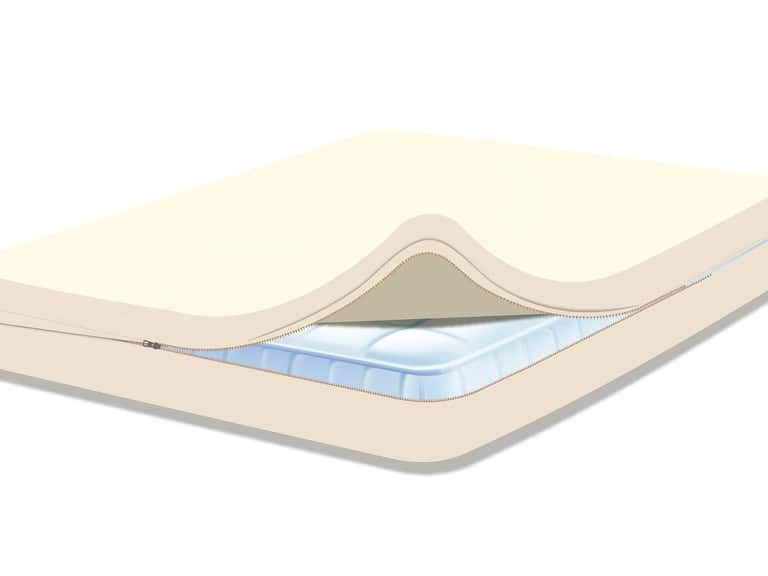
For an everyday spill barrier, a waterproof protector is a different tool from a cotton-and-wool quilted pad. The [Sleep and Beyond Organic Cotton Zippered Mattress Encasement](/products/sleep-and-beyond-organic-cotton-zippered-mattress-encasement-251), for example, is described as a zippered, waterproof design that encloses the mattress and uses a cotton jersey surface with a moisture barrier. That construction addresses coverage in a way a wool-filled fitted protector may not. The comparison is not a contest: it is a reminder to match the product’s stated function to the reason for using it.
A practical way to choose
Begin with the problem the protector is meant to solve. If the aim is to add a washable layer against ordinary wear while retaining a soft, textile feel, a quilted cotton-and-wool design may be worth considering. If the principal concern is liquid penetration, seek a product that explicitly identifies itself as waterproof and check whether it covers the top alone or the full mattress. For pest-related protection, examine whether the design is an encasement and read its specifications closely.
Then consider the bed itself. Measure the mattress, account for its depth, and note any topper. A fitted skirt must have enough room to hold securely without stretching uncomfortably or slipping loose. Think about how much extra loft you want: the more substantial the padding, the more likely it is to change the immediate feel of the mattress.
Finally, be realistic about upkeep. A natural-fiber pad that needs careful washing may be a good choice for a household willing to follow those instructions. It may be less practical for someone who needs frequent, simple laundering. The best material is not necessarily the one with the most appealing description; it is the one whose care, protection, and feel make sense in daily use.
- For a softly padded surface: look at the filling, quilting, and overall thickness, not just the fiber names.
- For spill resistance: confirm that the protector is explicitly waterproof; absorbent natural fibers are not a substitute for a barrier.
- For a secure fit: check the pocket depth and the full height of the mattress with any topper in place.
- For easier maintenance: read washing and drying directions before purchase, especially when wool is part of the construction.
- For a particular health concern: seek product-specific documentation and appropriate professional guidance rather than relying on broad marketing language.
The quiet work of a good layer
Mattress protection is most successful when it does not demand attention. A protector should fit without shifting, feel compatible with the bed, and perform the task for which it was chosen. Cotton and wool offer one approach: cotton provides the fabric surface, while wool adds a quilted, softly insulating filling. Together, they can create a breathable-feeling, cushioned layer that helps shield a mattress from routine wear, though they should not be mistaken for waterproofing unless the construction specifically includes it.
Vispring’s cotton-covered, wool-filled protector makes the material relationship tangible. Its value lies not in a grand claim about sleep, but in the ordinary mechanics of bedding: what touches the sleeper, what absorbs or releases moisture, what can be washed, and what remains protected underneath. The final judgment belongs to the person making the bed, because comfort is lived rather than declared.
In the end, the details that matter most are practical. Know what each layer is made to do. Check the fit. Follow the care label. And remember that a protector is part of a system, not a single-material solution to every problem. Cotton and wool can be a thoughtful pairing, but their influence is clearest when their strengths—and their limits—are understood.
Frequently asked questions
Does a wool mattress protector keep a mattress dry?
Wool can absorb moisture, but that does not make a wool-filled protector waterproof. For protection from liquid spills, choose a product whose specifications explicitly describe a waterproof barrier.
What does cotton contribute to mattress protection?
Cotton forms a familiar textile surface and can absorb some moisture. Its feel and airflow depend on the fabric construction and the other layers in the product and bed.
Can a cotton-and-wool protector change how a mattress feels?
Yes. Quilting and filling add a layer between the sleeper and the mattress. The amount of change depends on thickness, loft, and personal preference.
How should a wool-filled mattress protector be washed?
Follow the product’s care label rather than assuming all wool bedding can be cleaned the same way. For the Vispring Lux Skirted Mattress Protector, the stated directions call for a gentle cold wash, low-heat or line drying, and avoiding fabric softeners and bleach.